



Estimated reading time: 5 min · Updated November 20, 2026
- Verify current Ministry of Finance accreditation before comparing commercial proposals.
- Demand a live demonstration using your actual invoice scenarios and ERP data.
- Evaluate total cost, incident ownership and exit rights—not just the monthly fee.
UAE e-invoicing ASP selection is a procurement and operational-risk decision, not simply a software subscription. The right Accredited Service Provider (ASP) must fit your finance processes, ERP environment, customer and supplier data, information-security requirements and implementation timetable.
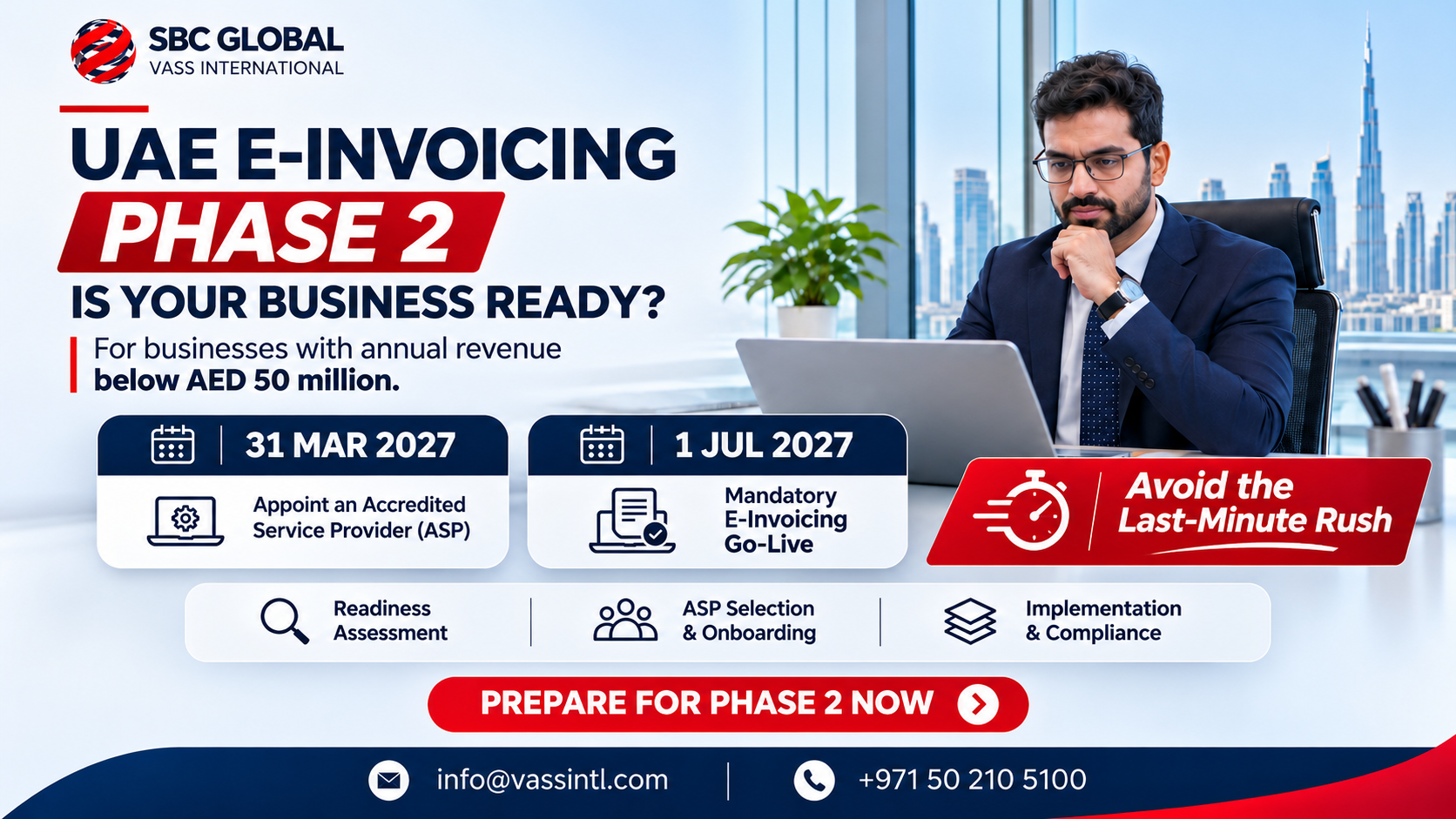
Before requesting quotations, confirm whether your business is in scope and its applicable phase. The FTA’s 25 October 2026 announcement states that in-scope persons with revenue of AED 50 million or more had an ASP appointment deadline of 30 October 2026 and must implement by 1 January 2027. Those below AED 50 million have an ASP appointment deadline of 31 March 2027 and an implementation deadline of 1 July 2027. These dates are phase-specific; review the latest official instructions for your circumstances.
UAE e-invoicing ASP selection: the 12-question scorecard
1. Are you currently accredited by the Ministry of Finance?
Ask for the exact legal entity name and accreditation number, then cross-check the live MoF accredited provider list. A sales brochure, Peppol certification or historical pre-approval alone should not replace this check. The October 2026 accreditation framework update replaced the earlier pre-approval framework.
2. Which of our legal entities and transaction flows are covered?
Provide a written map of group companies, branches, buyer/seller roles, domestic and cross-border flows, credit notes and relevant exclusions. Ask the provider to identify which flows need separate configuration, and have your tax adviser confirm the scope rather than assuming all transactions are identical.
3. Can you integrate with our actual ERP version?
Request a demonstration against your production ERP version or a representative sandbox. Clarify whether the connection uses supported APIs, middleware, file exports or custom development, and who maintains it after software upgrades.
4. How will invoice fields be validated before transmission?
Test tax identifiers, customer master data, line descriptions, currencies, tax treatment, credit-note references and missing mandatory fields. Ask for a documented rejection queue with ownership and correction steps. Our ERP data mapping guide explains common preparation errors.
5. What happens when an invoice is rejected or a system is unavailable?
Ask for a written incident playbook covering detection, alerts, retry logic, reconciliation, support escalation and evidence retention. Confirm which actions are automated and which require finance-team approval. Do not assume a rejected transmission is resolved just because the invoice exists in the ERP.
6. What security and data governance evidence can you provide?
Request details of encryption, access controls, audit logs, subcontractors, data location, backup and recovery arrangements, and independent assurance reports where available. Review contractual access and retention provisions with your legal and security teams.
7. Who owns onboarding and EmaraTax steps?
Define responsibilities for provider contracting, business registration details, configuration, testing and final onboarding. The MoF’s four-corner model explanation describes contracting with an ASP and completing onboarding. EmaraTax is used for onboarding, not for exchanging invoices.
8. How are incoming invoices handled?
Evaluate supplier invoice reception, duplicate detection, matching with purchase orders, approval workflows and export into accounts payable. A provider that only demonstrates outgoing sales invoices may leave half of your operational workflow unresolved.
9. What is included in the full commercial quotation?
Request a breakdown for setup, entities, connectors, implementation, invoice volume, storage, support, custom changes, training and future expansion. Ask for assumptions and overage charges in writing so competing bids are genuinely comparable.
10. What support is available during critical finance periods?
Confirm service hours, escalation contacts, response targets, maintenance windows and disaster recovery commitments. Ask how support works during month-end closing, holidays and high-volume billing periods, not only during onboarding.
11. Can we export our data and switch providers?
Clarify ownership of invoice data, export formats, retention obligations, termination fees, migration assistance and transition periods. An exit plan protects business continuity and reduces vendor lock-in.
12. Will you run a measurable pilot before go-live?
Insist on representative test cases: standard invoices, tax variations, credit notes, high-volume batches, invalid customer details and connectivity failures. Define acceptance criteria, named approvers, unresolved-defect thresholds and sign-off evidence.
A practical comparison matrix for your shortlist
Use a weighted score rather than selecting the lowest headline price. A sensible starting point is accreditation and regulatory fit (pass/fail), integration capability (25%), exception handling (20%), security and continuity (20%), implementation and support (20%), and total commercial cost (15%). Adjust weights to reflect your business risks.
Ask each shortlisted ASP to demonstrate the same five transaction scenarios and answer the same questions. Record supporting evidence, not just verbal assurances. Keep the scorecard with your procurement approval and implementation plan.
Three mistakes that can delay implementation
Choosing before cleaning master data: Even a capable ASP cannot fix inconsistent identifiers or incomplete ERP mappings without business decisions. Start with a structured data review.
Confusing accreditation with implementation readiness: Accreditation is essential, but it does not prove a provider has already integrated your particular ERP, entities or transaction volumes.
Leaving responsibility ambiguous: Document the split between your business, ERP vendor, ASP and adviser. Your organisation remains responsible for its applicable obligations, even when specialists perform technical work.
What should happen after selection?
Set a named implementation owner and work backwards from the applicable official deadline. Complete contract review, integration design, master-data corrections, user acceptance testing, incident procedures and training. The MoF e-invoicing guidelines and FTA e-invoicing resources should be checked as requirements evolve.
For the underlying financial records, reconcile invoice totals to sales ledgers, tax reports and credit notes. VASS provides outsourced accounting and bookkeeping and e-invoicing readiness advisory within agreed scopes; VASS should not be represented as the accredited technology provider unless that status is separately verified.
Make your ASP shortlist decision-ready
Get a structured review of data readiness, finance controls, implementation responsibilities and vendor questions before committing.