




Estimated reading time: 4 min · Updated November 5, 2026
A UAE monthly accounting close checklist helps finance teams turn scattered transactions into reliable management reports. Instead of waiting until year-end to find missing invoices, unmatched payments or incorrect balances, a disciplined monthly close assigns each check an owner, evidence and deadline. Here is a practical workflow that UAE businesses can adapt to their size, systems and reporting needs.
UAE monthly accounting close checklist: the five-stage workflow
Start with a fixed cut-off date, then work through source documents, reconciliations, adjustments, review and sign-off. A smaller business may complete these stages in a few working days; a larger business with several entities or currencies may need longer. The aim is consistency, not an arbitrary universal deadline.
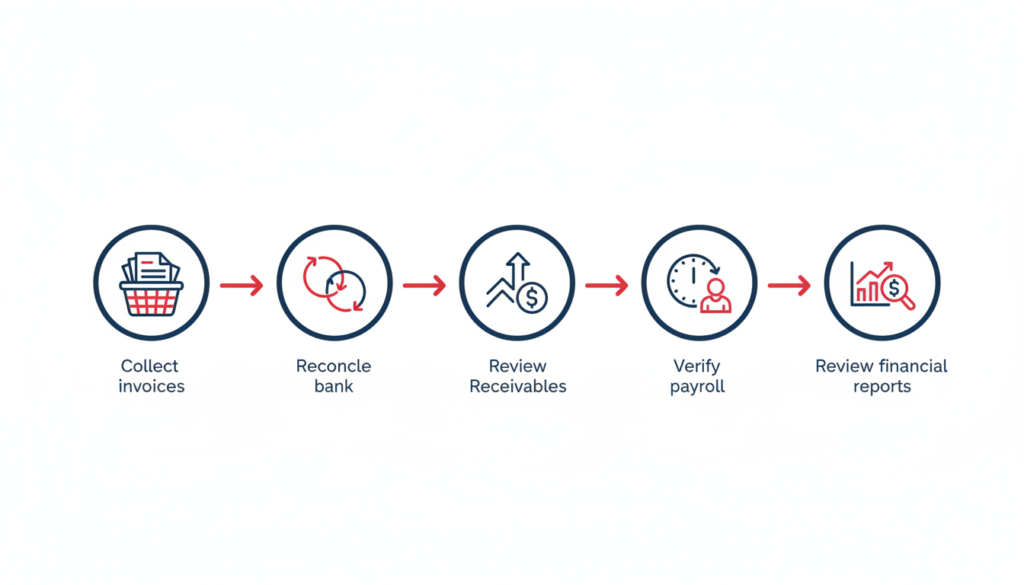
1. Collect and classify source documents
Confirm that sales invoices, supplier bills, credit notes, receipts, expense claims, payroll journals and bank statements for the period are available. Investigate gaps before posting estimates. Check that documents are dated in the correct period and attached to the related ledger entries. Record late-arriving items in an exception log rather than silently changing a previously approved month.
2. Reconcile every bank and payment account
Match the general ledger to bank statements and payment gateways. Identify outstanding cheques, bank fees, card settlements, transfers in transit and duplicated entries. Keep a reconciliation file showing the opening balance, movements, closing balance, outstanding items and reviewer approval. Investigate old unmatched transactions rather than carrying them forward indefinitely.
3. Review receivables, payables and inventory
Compare customer and supplier subledgers with the general ledger. Review aged receivables, disputed invoices, unapplied receipts, overdue supplier balances and supplier statement differences. Where relevant, reconcile stock movements, inventory counts and cost of sales. Document whether adjustments are required for damaged, obsolete or slow-moving stock under the applicable accounting framework.

4. Post supported accruals and review payroll
Review recurring expenses, prepaid costs, depreciation, employee-related balances and other period-end estimates. Every material adjustment should have a calculation, supporting evidence and an approver. Reconcile payroll totals and payment records to the ledger; limit access to sensitive employee information. Do not use a balancing journal simply to make an unexplained difference disappear.
5. Produce and approve management reports
Prepare a profit-and-loss statement, balance sheet, cash-flow summary and variance analysis suited to management needs. Compare actual results with the previous month and budget. Ask why gross margin, cash balances, overdue debts or major expenses moved. Have someone other than the preparer review significant reconciliations and journal entries where staffing permits. Lock the period after approval, with controlled procedures for subsequent corrections.
How monthly close supports UAE tax readiness
Clean accounting records make it easier to substantiate figures used in VAT and Corporate Tax reporting, but a completed monthly close is not itself a tax filing or proof of tax compliance. Keep a separate tax review to check invoice treatment, adjustments and supporting records. The UAE Ministry of Finance explains that accounting income is the starting point for Corporate Tax taxable-income calculations, subject to tax adjustments. The Federal Tax Authority stresses the need to retain documentation supporting Corporate Tax returns. See the Ministry of Finance Corporate Tax overview and FTA record-keeping guidance.
For Corporate Tax purposes, Article 56 of Federal Decree-Law No. 47 of 2022 generally requires taxable persons to retain supporting records for seven years after the relevant tax period; exempt persons have a related record-retention obligation. This is a tax-law requirement, not a claim that every business must follow the same monthly close timetable. Check the official Corporate Tax Law, Article 56 and seek advice on any additional obligations that apply to your business.
Common closing errors—and how to prevent them
- Unexplained reconciling items: assign an owner and target resolution date.
- Late supplier invoices: maintain a cut-off register and assess whether an accrual is appropriate.
- Duplicate payments: match invoice references, suppliers and amounts before posting.
- Missing approvals: require evidence for material manual journals.
- Unreliable reports: reconcile control accounts before distributing management figures.
A reusable month-end close tracker
Create a simple tracker with six columns: task, account, preparer, reviewer, evidence link and status. Mark each item not started, in progress, blocked or approved. Review blocked items daily until the close is signed off. Track how many corrections arise after sign-off: repeated issues often reveal a process or training problem rather than a one-off bookkeeping error.
When should a business get external accounting support?
Consider specialist support if reconciliations routinely remain open, management reports arrive too late to guide decisions, several systems do not agree, or the finance team needs an independent review of controls. A useful engagement should define deliverables, responsibilities, document access, reporting frequency and the escalation process for unresolved items—not just promise “compliance.”
A better month-end starts with better accounting.
Less time resolving discrepancies. More clarity in your financial reporting. Get professional accounting support tailored to your business.
Accounting & Bookkeeping · Dubai, UAE
This article provides general operational guidance, not individualized tax, audit or legal advice. Apply the relevant law, accounting standards and sector-specific requirements to your circumstances.