


Estimated reading time: 6 min · Updated November 2, 2026
UAE e-invoicing Phase 2 is approaching, and choosing an Accredited Service Provider (ASP) is only the first step. Businesses also need to confirm whether they are in scope, assess their accounting systems, plan integrations and test how invoice data will flow. This practical guide explains the 2027 milestones and the questions finance and IT teams should ask before signing an ASP contract.
Regulatory information checked against official UAE Ministry of Finance and Federal Tax Authority publications as of 2 November 2026. Applicability depends on the relevant legislation and the nature of your transactions.
UAE e-invoicing Phase 2 deadlines compared with Phase 1
The Federal Tax Authority (FTA) confirmed the following milestones for persons subject to the UAE e-invoicing system:
| Requirement | Phase 1 | Phase 2 |
|---|---|---|
| Annual revenue | AED 50 million or more | Below AED 50 million |
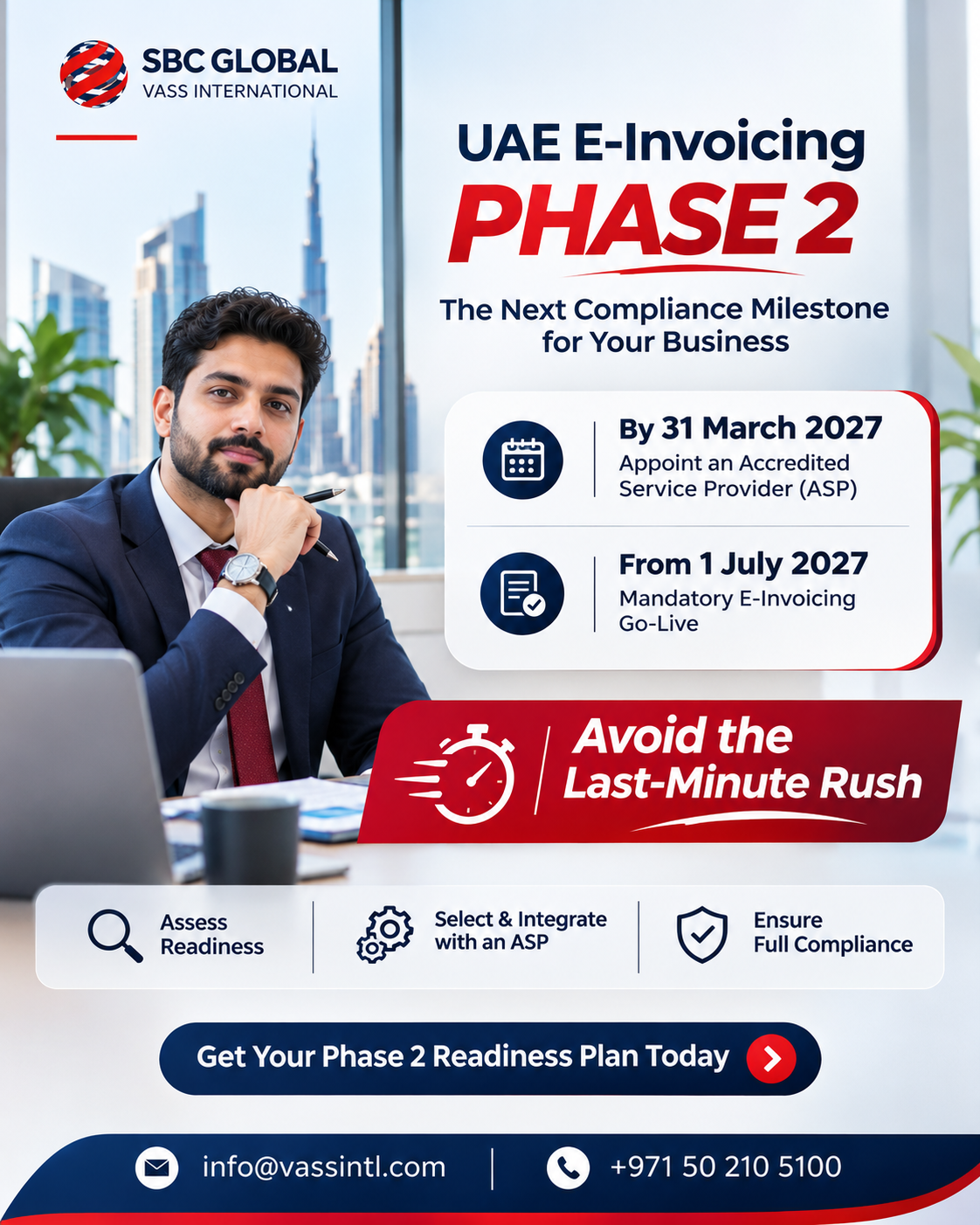
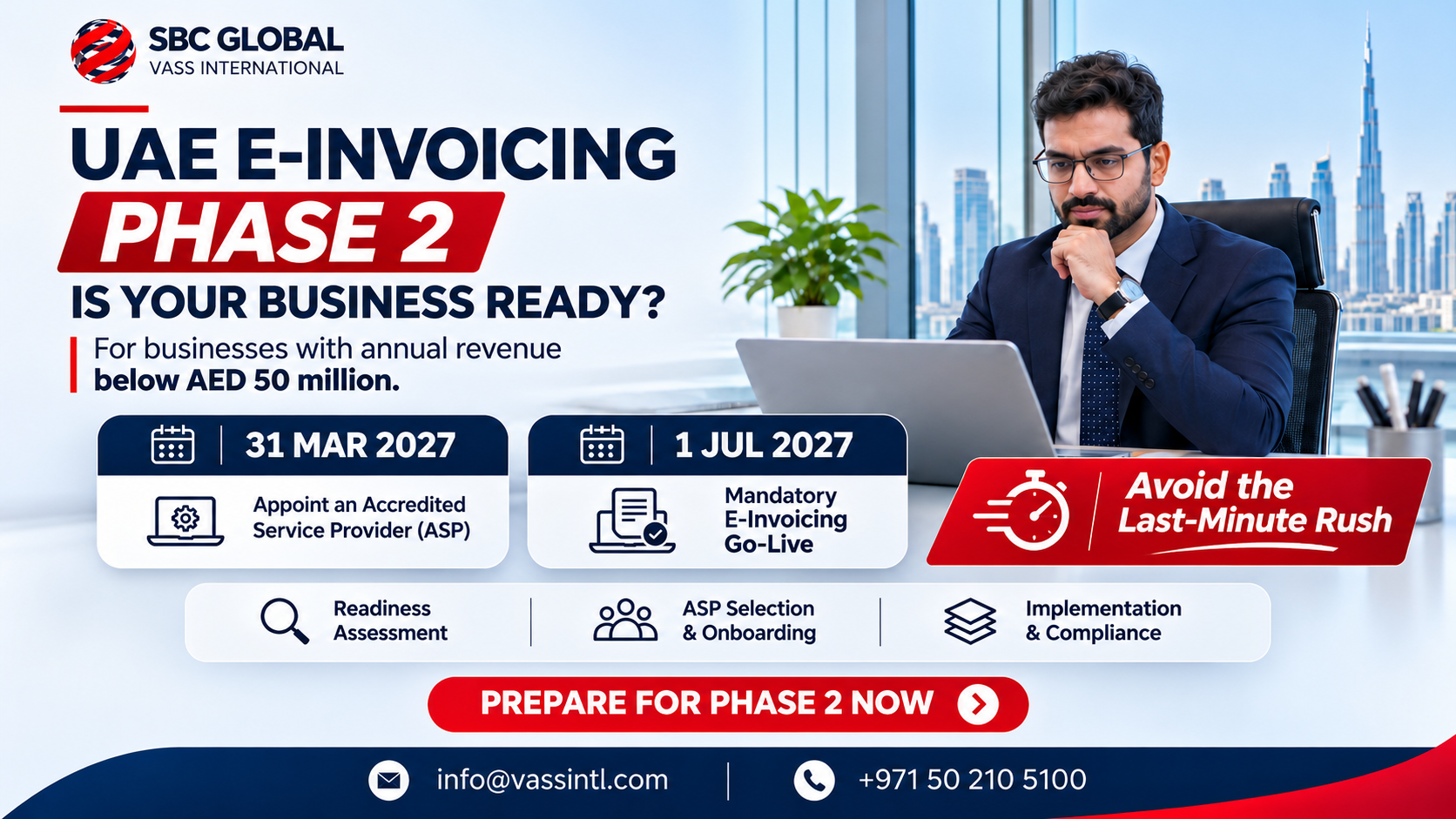
| Appoint an Accredited Service Provider | 30 October 2026 (passed) | 31 March 2027 |
| Implement e-invoicing | 1 January 2027 | 1 July 2027 |
These are the FTA’s published dates in its 25 October 2026 announcement. The revenue band is a timing distinction for in-scope persons, not a substitute for assessing whether a business and its transactions fall within the rules. Government entities have a separate timetable; check the official Ministry of Finance e-invoicing portal for the current framework.
What is an Accredited Service Provider, and why does the choice matter?
An ASP is a service provider accredited to support the structured exchange of electronic invoices under the UAE framework. An ordinary emailed PDF is not, by itself, a compliant e-invoice: the FTA describes an e-invoice as structured data issued and exchanged electronically, with reporting to the Authority. The selected provider therefore needs to work with your invoicing, customer, supplier and accounting processes—not just generate a printable document.
Start with the Ministry of Finance’s official list of Accredited Service Providers, which is updated periodically. The Ministry announced an updated accreditation framework under Ministerial Decision No. 168 of 2026, replacing the earlier pre-approval approach. Read the 9 October 2026 accreditation update before relying on older vendor claims.
10 questions to ask before choosing a UAE e-invoicing ASP
1. Is the provider currently accredited?
Check the exact legal entity and accreditation entry on the official MoF list. Do not treat an old pre-approval announcement or a sales brochure as sufficient evidence of current accreditation.
2. Will it integrate with our existing accounting or ERP system?
Ask for a demonstration using your actual invoice workflow: sales invoices, credit notes, customer master data, VAT details and approval steps. Identify any custom connector or middleware work before committing.
3. What invoice formats and data fields are supported?
Confirm how the provider maps your source data to the UAE’s required structured e-invoice format, validates mandatory fields and handles missing or inconsistent customer details. The MoF portal publishes official electronic-invoice guidelines and mandatory-field requirements.
4. How are errors, rejections and corrections handled?
Request a walkthrough of failed validations, rejected exchanges, credit-note scenarios, resubmissions and audit trails. Define who resolves issues and how quickly.
5. Can we track invoice delivery and reporting status?
Finance teams need visibility beyond a simple ‘sent’ status. Ask what dashboards, status messages, alerts and reconciliation reports are available, and how they link back to your ledger.
6. What is included in the quoted price?
Separate setup, integration, testing, user training, recurring platform fees, invoice-volume charges, support and change requests. Ask how the price changes if transaction volume grows.
7. Who owns our data and how can we export it?
Check contractual provisions covering access, retention, confidentiality, backups, data portability, service exit and transition to another provider. Involve your information-security team before transferring sensitive commercial data.
8. What happens during an outage?
Ask for documented continuity procedures, incident communications, recovery targets and escalation contacts. Verify that your internal team understands how invoice processing will resume after a disruption.
9. What onboarding work is required in EmaraTax?
The FTA advises businesses to select and contract with a suitable ASP, integrate with that provider and complete the relevant steps through EmaraTax. Ask who will perform each step, who has authority to approve it and what evidence of completion will be retained. See the FTA’s implementation reminder.
10. Can the provider complete testing before our deadline?
Request a written implementation plan with named owners, test scenarios, acceptance criteria and realistic contingency time. Signing a contract close to the deadline does not guarantee a production-ready integration.
A practical 6-step readiness plan for Phase 2 businesses
- Confirm scope and deadline: document annual revenue, relevant business activities, transaction types and the legal entities involved; obtain professional advice for unusual cases.
- Map invoice workflows: identify who creates invoices, where data is stored, how credit notes are processed and which teams approve transactions.
- Clean master data: review customer and supplier records, tax identifiers where relevant, item descriptions, invoice references and tax treatment.
- Shortlist accredited providers: compare integration, support, controls, commercial terms and implementation capacity using the same evaluation scorecard.
- Test end to end: run representative invoice and credit-note cases, including error handling, status tracking and reconciliation with the accounting ledger.
- Train and monitor: assign finance/IT owners, retain test evidence, document escalation paths and monitor exceptions after go-live.
Businesses already working on ERP upgrades may benefit from reviewing their wider accounting and bookkeeping processes at the same time. For tailored implementation support, explore VASS International’s UAE e-invoicing readiness services.
What are the updated UAE e-invoicing penalties?
On 30 October 2026, the Ministry of Finance announced a revised penalty framework replacing Cabinet Decision No. 106 of 2025. For specified issuer/recipient implementation violations, the announced structure is AED 5,000 for the initial violation, then AED 5,000 for each month or part of a month of continued non-compliance, with a maximum aggregate AED 50,000 for those violations within any 12 consecutive months. This is not a universal cap on every e-invoicing offence; the applicable decision and facts govern. See the Ministry of Finance’s 30 October 2026 announcement.
The right response is to identify obligations early, document the project and address gaps before the relevant deadline. A missed appointment milestone does not, on its own, establish the exact penalty payable in every individual case.
Frequently asked questions
Is sending a PDF invoice by email enough?
No. The FTA distinguishes structured electronic invoice data from unstructured PDFs, Word files, images, scans and emails. Review the official e-invoicing guidelines for the required approach.
Does a business below AED 50 million have to act now?
If it is subject to the e-invoicing system, the Phase 2 ASP appointment deadline is 31 March 2027 and implementation is due by 1 July 2027. Provider selection, integration and testing can take time, so early preparation is sensible.
Can we choose any invoicing software vendor?
Software functionality alone does not establish that a provider is an accredited ASP. Verify accreditation through the Ministry of Finance ASP directory and separately assess integration with your existing systems.
Will an ASP manage all our internal compliance responsibilities?
An ASP provides an essential part of the exchange infrastructure, but businesses still need accurate invoice data, appropriate controls, trained staff and oversight of their own processes. Define responsibilities contractually and operationally.
Get your UAE e-invoicing readiness plan
VASS International can help businesses assess invoice workflows, review accounting and ERP readiness, compare ASP options and develop a practical compliance roadmap. Request an e-invoicing consultation with VASS International to identify your next steps before the applicable deadline.
Official UAE sources
- Federal Tax Authority — 25 October 2026 implementation deadlines and onboarding guidance
- Ministry of Finance — UAE e-invoicing portal, guidelines and legislation
- Ministry of Finance — Accredited Service Provider directory
- Ministry of Finance — 9 October 2026 ASP accreditation update
- Ministry of Finance — 30 October 2026 updated administrative penalties